

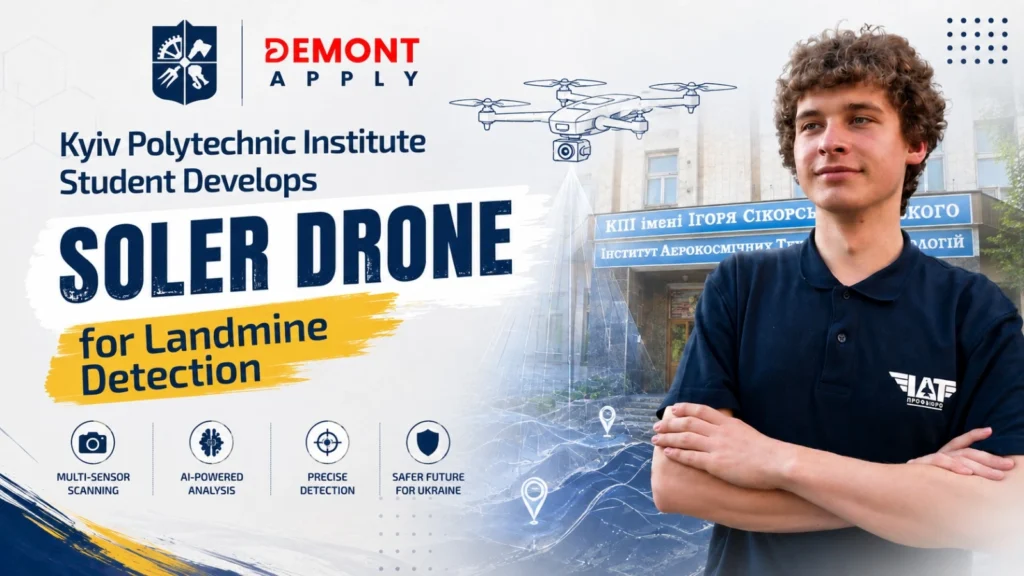
KPI Student Develops SOLER Drone for Landmine Detection
Twenty-year-old Igor Sikorsky Kyiv Polytechnic Institute student Yurii Yurchuk, together with his team, is developing the SOLER unmanned aerial vehicle — an innovative system designed to make the surveying of potentially mined areas safer and more efficient for demining specialists.
For Ukraine, this development is particularly important. Amid the ongoing war, technologies capable of reducing risks for demining specialists and accelerating land surveys are becoming an essential part of the future of humanitarian demining.
SOLER combines avionics, electronics, software, sensor technologies, and artificial intelligence. The drone simultaneously scans the terrain using three sensors — a conventional camera, a thermal imaging camera, and a magnetometer. After the flight, specialized software analyzes the collected information and identifies areas where mines or other explosive objects may potentially be located.
From Childhood at KPI to Choosing Avionics
Yurii was born and raised in Kyiv and has been connected with Igor Sikorsky Kyiv Polytechnic Institute from an early age. He first studied at the university’s Polytechnic Lyceum and later attended KPI’s Technical Lyceum from fifth through eleventh grade.
When choosing his future field of study, he considered several options. At the time, programming did not seem particularly appealing to him, while theoretical physics and mathematics, although interesting, felt too abstract. Yurii wanted to work on something more practical.
He therefore chose engineering and, among engineering disciplines, avionics.
Avionics became an ideal combination of aviation, electronics, and autonomous technologies for him. His interest in aviation and space exploration began in childhood.
Simply put, avionics can be described as the “brain” of an autonomous vehicle. It is responsible for navigation, processing data from sensors, flight control, and the operation of electronic systems.
During their studies, students learn to design electronic systems and develop software capable of operating reliably under a wide range of conditions. These skills allow specialists to work not only with drones, but also with a broad range of modern technologies — from robotic systems to satellites.
Even amid war and frequent air-raid alerts, students continue to study, work in laboratories, and develop their own engineering projects.
SOLER: A Drone Designed to Detect Mines
SOLER is the name of the unmanned aerial vehicle the team has been developing since last year. The name comes from the Latin word sol, meaning “sun.” For the developers, it symbolizes a simple but powerful dream: for the sun to shine over Ukrainian fields again and for people to be able to walk across them safely.
The project began with Yurii’s initiative. The team first participated in the AI Labeling Sprint organized by The DeMine Ukraine, where they worked on preparing data for mine-detection algorithms.
The students then took part in OL Fest, an engineering competition where they developed a concept for an unmanned surface vehicle for demining. They created a 3D model, designed the structure, considered sensor placement, and developed the operating concept.
When KPI announced the Sikorsky Challenge competition, the team decided to continue developing the idea. Initially, they planned to improve the surface drone, but eventually concluded that an aerial platform better matched their knowledge and interests in avionics.
This is how SOLER was born.
How the System Works
SOLER is based on the integrated collection and analysis of information.
During a flight, the drone surveys a designated area and simultaneously collects data from three sensors:
a conventional camera; a thermal imaging camera; a magnetometer.
After the drone returns to the ground station, the collected information is processed by specialized software.
The algorithms analyze various indicators that may potentially point to the presence of mines or other explosive objects, including temperature anomalies, disturbances in the soil surface, unusual reflections, characteristic shapes, and magnetic anomalies.
The system then identifies GPS coordinates of areas that may require further inspection. These potentially dangerous locations must subsequently be examined by professional demining specialists.
The main purpose of SOLER is therefore not to replace demining specialists, but to help them conduct preliminary surveys of large areas and provide additional information that can make their work more efficient and safer.
From an Idea to a Comprehensive Technology
While working on the project, the team quickly realized that knowledge of avionics alone was not enough. The students had to study humanitarian demining in greater depth, communicate with specialized organizations and experts, attend professional events, and learn from practical experience.
Particular attention was paid to the technical aspects of the project: which sensors are most effective for detecting potential mines, at what altitude the drone should fly, which camera should be used, and how information from different sensors should be combined.
The team’s goal is not simply to create another drone, but to develop a comprehensive technological system that can genuinely help specialists survey potentially dangerous areas faster and more effectively.
SOLER is being developed by Yurii together with his friends and fellow students. One team member is responsible for software, another for the mechanical structure and 3D model, another for prototype assembly, while other members work on firmware and the artificial intelligence system that analyzes data collected during flights.
Yurii coordinates the project, searches for components, handles organizational tasks, and participates in testing.
For a student team, managing such a complex project is a serious challenge. It requires constant progress monitoring, task distribution, and solving technical problems as they arise.
Training Data and Artificial Intelligence
The team uses data obtained during testing as well as information from other sources to train its models. Students work with data collected at testing grounds in the Kyiv region and also receive information from military personnel and organizations working with mined territories.
The developers understand that similar technologies already exist both in Ukraine and abroad. However, their goal is to develop their own approach in which the key element is not only the drone platform itself, but also software capable of comprehensively analyzing the collected data.
In the future, the team wants to make the system even more versatile. For example, users could potentially upload video footage recorded by an ordinary drone, provided that flight parameters such as altitude, speed, and camera angle are known.
The algorithm could then process the video, compensate for potential inaccuracies, and identify coordinates of areas requiring further inspection.
First Tests: Failure as Part of Development
The SOLER project is currently at the research, development, and testing stage.
The first tests in the Kyiv region were unsuccessful. At that stage, the artificial intelligence model did not yet provide sufficient accuracy, and the system relied only on a conventional camera.
The team quickly concluded that a single source of information was not enough. They therefore added a thermal imaging camera and a magnetometer to combine data from different sensors and improve the quality of the analysis.
The unsuccessful tests became an important stage in the team’s development.
When the first tests failed to produce the expected results, it was a significant emotional challenge for the developers. However, these experiences helped them identify weaknesses in the technology and understand which solutions needed to be changed.
The team now has two drones: one more advanced and refined, and another used for experiments with new components and technical solutions.
Following further improvements, the developers conducted additional tests in the Kyiv region and continue to work with data obtained from other regions.
Key Technical Challenges
One of the most difficult tasks is ensuring high-quality analysis of information obtained simultaneously from multiple sensors.
The team needs to teach the system how to correctly combine different types of data and identify patterns that may not be visible when each individual source is analyzed separately.
This is why the project needs specialists in machine learning, multispectral data analysis, and artificial intelligence.
There are also objective limitations associated with individual technologies. For example, the effectiveness of thermal imaging depends on soil temperature, time of day, and weather conditions. Developers therefore need to conduct testing under different conditions to determine the system’s real-world capabilities.
At the same time, the accuracy requirements for such technology are extremely high. Any potentially missed anomaly can create additional risk. The team is therefore working toward the highest possible sensitivity and aims to generate the most comprehensive possible map of potential threats.
SOLER is intended specifically as a tool for preliminary surveying and decision support. The final assessment of any potentially dangerous object must be carried out by qualified demining professionals.
Ukraine Needs Its Own Technologies and Components
Working on SOLER has also influenced Yurii’s future professional plans. After graduating, he wants to develop his career in microelectronics.
During the development of the drone, the team repeatedly encountered dependence on foreign components. Many of the required elements have to be purchased abroad, including from Asian countries.
This experience demonstrated to the developers how important it is for Ukraine to build its own electronics ecosystem and develop expertise in chip design and microelectronics.
The development of domestic electronic components and microelectronics can become an important part of Ukraine’s technological independence and provide a foundation for the continued growth of the country’s engineering sector.
What the Future of Demining Could Look Like
Yurii sees the future of humanitarian demining as highly automated.
In the long term, dangerous areas could be surveyed by drones, ground robots, and other autonomous systems, while people would operate the technology, supervise its performance, and make key decisions.
The less time demining specialists have to spend directly in potentially dangerous areas, the greater the opportunity to save human lives.
The SOLER story demonstrates how university knowledge can be transformed into real technological solutions. Engineering education, teamwork, participation in hackathons and competitions, practical experience, and the willingness to learn from mistakes allow students to develop projects aimed at addressing real challenges facing Ukraine.
The team’s greatest dream is simple: for Ukrainian fields to become safe again — so that people can work there, grow crops, build the future, and simply walk freely.
Want to Study at KPI and Build the Technologies of Tomorrow?
The SOLER story is also a story about the opportunities that modern technical education can provide. If you are interested in avionics, engineering, IT, artificial intelligence, robotics, unmanned technologies, and innovation, studying at KPI can be the first step toward your own professional success story.
Demont Apply helps prospective students apply to Igor Sikorsky Kyiv Polytechnic Institute and begin their education in modern technical fields.
If you want an education that allows you not only to study technology but also to create your own innovative projects, Demont Apply can help you take the next step.
Apply Now — start your journey toward modern technical education with Demont Apply!
Demont Apply — helping turn the ambition to learn into real educational and professional opportunities.