

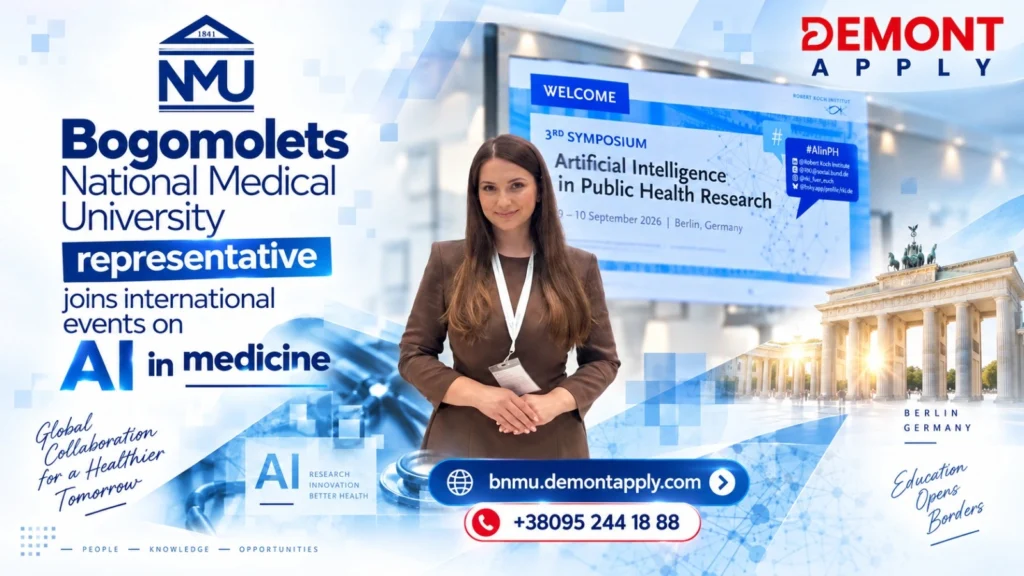
BNMU Representative Takes Part in International Events on Artificial Intelligence in Medicine
On 9–10 September 2026, prestigious international events were held in Berlin, Germany — the 3rd Symposium of the Robert Koch Institute “Artificial Intelligence in Public Health Research” and the Annual Meeting of the EUPHA Section on Digital Health and Artificial Intelligence. The Bogomolets National Medical University was represented by Inna Kucherenko, Head of the Department of Educational and Methodological Work, Licensing and Accreditation, Associate Professor.
The events focused on the application of Artificial Intelligence (AI) in public health research and practice — a topic that is becoming increasingly important in medical education, particularly in the areas of methodological support, licensing and accreditation of educational programmes.
Participation in such international events enables specialists to explore how leading European institutions are implementing AI in research, healthcare practice and regulatory frameworks. It also provides an opportunity to discover practical tools for working with large language models (LLMs) that can support educational and methodological activities.
The Robert Koch Institute (RKI) Symposium “Artificial Intelligence in Public Health Research” was held at Germany’s federal ministries with financial support from the Federal Ministry of Health of Germany within the AI-DAVIS-PANDEMICS project. The programme was opened by Parliamentary State Secretary Dr. Georg Kippels and Acting Vice-President of the Institute, Professor Johanna Hanefeld.
The first day focused on the reliability of AI systems and the use of AI to support decision-making in infectious diseases and antimicrobial resistance, non-communicable diseases and prevention. Speakers included representatives of the Robert Koch Institute, Finnish Institute for Health and Welfare, Carl von Ossietzky University, Fraunhofer Heinrich Hertz Institute, Charité – Universitätsmedizin Berlin, and Yerevan State Medical University.
The second day addressed regulatory and ethical aspects of AI and machine learning in medicine, as well as the impact of climate change on public health. Presentations were delivered by specialists from Imperial College London, the European Commission’s Directorate-General for Health and Food Safety, the German Federal Ministry of Health, and the University of Copenhagen. The symposium concluded with a keynote lecture by Professor Anna Odone of the University of Pavia, “Rethinking Public Health Research in the Age of Artificial Intelligence: From Data to Evidence-Based Knowledge.”
The programme of the Annual Meeting of the EUPHA Section on Digital Health and Artificial Intelligence included two practical workshops. The first focused on the appropriate and inappropriate use of large language models (LLMs) for synthesising scientific evidence, developing search strategies and extracting data from full-text research. The second explored how to create a personal AI-assisted knowledge wiki using an AI agent — the “second brain” concept. Participants developed their own structured knowledge bases under the guidance of mentors. The event concluded with networking among participants.
The Robert Koch Institute (RKI) is Germany’s central federal public health institution. Its mission is to protect and improve population health through evidence-based research, epidemiological surveillance and independent scientific advice to the government and the healthcare sector, particularly during crises. The Institute employs around 1,500 people across nearly 90 professional fields and cooperates with the World Health Organization (WHO) and the European Centre for Disease Prevention and Control (ECDC). Its structure also includes the newly established Centre for Artificial Intelligence in Public Health Research (ZKIPH), created to strengthen the Institute’s analytical capabilities in this field.
The EUPHA Section on Digital Health and Artificial Intelligence brings together the European public health community to exchange expertise, contribute to policy development and promote evidence-based approaches to healthcare. EUPHA includes 72 national public health associations and institutions from 38 countries of the WHO European Region, 30 thematic sections, including Digital Health and Artificial Intelligence, and the EUPHAnxt network for students and young professionals. The Association publishes the European Journal of Public Health, published by Oxford University Press, organises Europe’s largest annual public health conference and coordinates European Public Health Week. The organisation is led by President Professor Anna Odone and Vice-President Dr Stefan Buttigieg.
🎓 Interested in studying at Bogomolets National Medical University?
Demont Apply can help you make it happen. From choosing a study programme and preparing your documents to admission support and the application process, our team is ready to guide international students through their journey to studying in Ukraine.
Explore the study programs & Apply: bnmu.demontapply.com
Contact Demont Apply: +380 95 244 18 88