

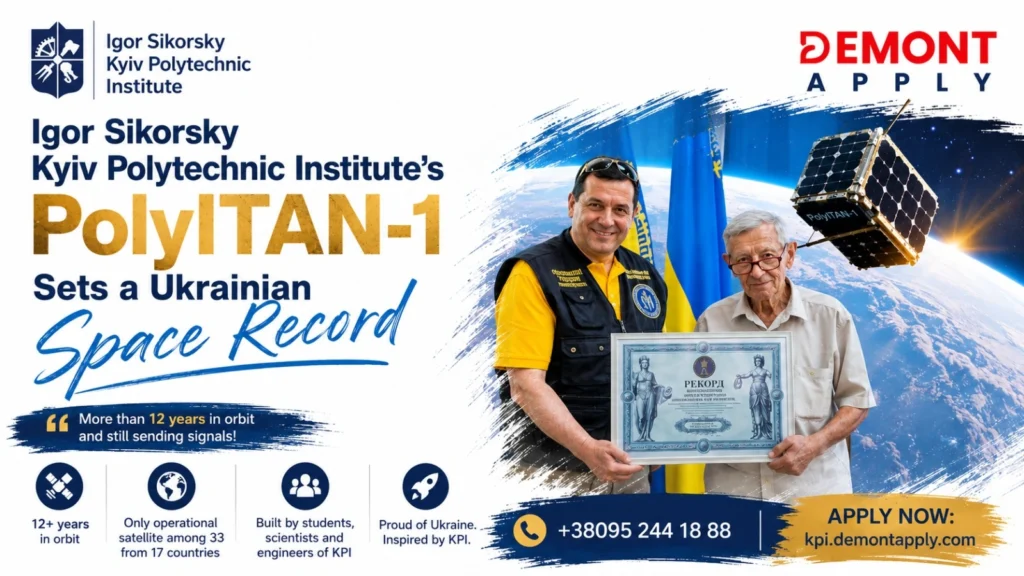
On July 30, Igor Sikorsky Kyiv Polytechnic Institute (KPI) officially established and registered a Ukrainian national record in the category “The Longest Flight of a Ukrainian Nanosatellite in Space.”
The university’s nanosatellite PolyITAN-1, which has been successfully operating in near-Earth orbit for more than 12 years, was entered into the Book of Records of Ukraine. The achievement was officially recorded by Vitaliy Zorin, an expert of the National Register of Records of Ukraine.
“KPI is working to restore Ukraine’s potential as a spacefaring nation. The university has launched three of its own satellites. One of them is PolyITAN-1, which set a record this year. Importantly, KPI researchers — including professors, PhD students and students — have been involved in developing the nanosatellite’s components. We have created a complete system for designing, manufacturing and testing small spacecraft and their components. We have developed the satellite’s power supply system, which provides energy to its main subsystems, as well as thermal regulation, orientation and navigation, communication and other systems. We have also established training for engineers in the space sector,” said Anatolii Melnychenko, Rector of Igor Sikorsky Kyiv Polytechnic Institute.
“PolyITAN-1 is truly impressive. No one expected the satellite to operate almost three times longer than originally planned during its design. Therefore, the success of PolyITAN-1 is undoubtedly 90% technology and 10% luck,” said Vitaliy Zorin, an expert of the National Register of Records of Ukraine.
The ceremony was attended by the nanosatellite developers and their scientific supervisor Borys Rassamakin, Oleksandr Korniienko, First Deputy Chairman of the Verkhovna Rada of Ukraine and Head of the Supervisory Board of KPI, representatives of the State Space Agency of Ukraine, the Main Astronomical Observatory of the National Academy of Sciences of Ukraine, and representatives of the KPI administration.
“The dream of breaking away from Earth has always inspired scientists and engineers to make great discoveries. Ukraine has been and remains a spacefaring nation, and it is thanks to teams like KPI that this tradition continues. Today, it is extremely important to develop our own space technologies and support engineering education, because it is engineering that shapes the future of the country. I congratulate the entire team. We will continue making every effort to ensure that engineering education in Ukraine remains prestigious and that talented young people receive state support. I am convinced that the students, PhD candidates and professors who worked on PolyITAN-1 have already achieved great professional heights and will achieve even more in the future. Today, KPI is present not only on Earth, but also in space,” said Oleksandr Korniienko, First Deputy Chairman of the Verkhovna Rada of Ukraine and Head of the Supervisory Board of KPI.
“Today’s event is extremely important not only for those who participated in this project, but also for educating a new generation. We want new people to enter the rocket and space industry — from KPI, from other universities and from schools. The space industry is an industry of the future, and the role of space and high technologies in our lives will only continue to grow,” said Eduard Kuznetsov, Head of the Public Council of the State Space Agency of Ukraine.
PolyITAN-1 was launched into orbit on June 19, 2014, aboard the Ukrainian Dnipro launch vehicle. For more than 12 years, the satellite has remained operational in near-Earth orbit and continues to transmit telemetry signals.
It is the only spacecraft among 33 satellites from 17 countries launched as part of the same mission that is still operating in space.
PolyITAN-1 became Ukraine’s first university nanosatellite and laid the foundation for the development of KPI’s modern space engineering school. KPI is the only university in Ukraine with its own space program.
This is one of the reasons why future space engineers choose KPI. Last year, more than 40% of all applicants to the “Aviation and Rocket-Space Engineering” specialty in Ukraine chose KPI.
This is especially important because the future of the space industry depends on people and their expertise.
The PolyITAN-1 project also marked the beginning of the development of a new generation of multifunctional KPI spacecraft. These satellites are designed for applications including high-precision imaging of the Earth’s surface and research of the Earth’s atmosphere.
KPI’s satellite development is the result of many years of cooperation between students, PhD candidates, professors and researchers from different faculties and educational and research institutes.
At Kyiv Polytechnic, future engineers can become involved in real space projects while still studying, transforming university laboratories into centers for the development of innovative technologies.
Study Engineering at KPI with International Student Support
For international students who want to build a career in aerospace, engineering, advanced technologies and space research, KPI offers an opportunity to study in an environment connected with real scientific and engineering projects.
Through Demont Apply, international students can receive professional assistance with university and program selection, application submission, admission procedures, document preparation and other essential steps for studying in Ukraine.
🌐 Apply Now: kpi.demontapply.com